Expediting the user's first product exposure
Harnessing the power of group chats

The Backstory 🤫
Imagine this! You open up the Uber app and instead of the screen that you’re familiar with, you see a group chat where thousands of users are requesting rides. To find a driver, you need to message I need a ride, which will then get broadcasted to everyone in the group. I bet you’re really confused right now and have probably come up with a myriad of questions trying to visualize the experience, “Wait what? Will I need to share my addresses in the group chat? What about my privacy? Will a driver message me? How would I see the driver or vehicle info? Why in the world would people do this?” These were precisely the questions that I asked myself when first experimenting with group chats on GroupMe to aggregate the first few hundred ride requests when launching in a new market. This was by far the most counterintuitive product that I had built but ultimately became one of our most impactful demand-side platform hacks that completely changed the trajectory of our launch playbook.
The inspiration to use GroupMe to facilitate rides came at a time when I was wrestling with the pace of our growth — it took us more than a month to aggregate our first 100 rides at a new campus. At this rate, how were we supposed to fulfill our promise to the drivers, investors, and ourselves that we’d take down Uber/Lyft? I wished I could blame COVID, which had robbed us one year out of our 1.5 years of operational time, but I knew deep inside my heart that the launch playbook we had built after two iterations, was mediocre at best.
Our fledgling growth only made more sense as I came to face a disheartening realization that there were a ton of friction points for a new user to overcome before taking their first ride on Nomad: after hearing about our service, a new user would have to search, download our app, create an account, and learn a whole new UI/UX flow. Not to mention that a new user would feel anxious about trying an unverified ridesharing service – Do other people use this? Did the drivers go through a background check? Am I going to get kidnapped or raped? Yes, these were actual questions I got asked when pitching Nomad to prospective users. We were fighting an uphill battle to change the well-established behavior of users and it felt like a near-damn miracle whenever we saw requests come in on Nomad.
But it wasn’t all doom and gloom! On the bright side, my conviction in our ability to steal market share from Uber/Lyft had become even stronger as I witnessed first-hand the stickiness of our product. Whenever I drove first-time users, I would often see the light bulb go off in their heads, “Oh wait, this is literally the same thing as Uber/Lyft, but it’s cheaper!” Stepping into our vehicle was the aha moment that would transform a skeptical user into a power user who would excitedly spread the Gospel of Nomad amongst their friend groups. For example, we had a large army of sorority girls who would request rides on Nomad up to five times a night! I knew that as long as I could get a user into our vehicles, they wouldn’t go back to Uber. Suddenly, my quandary about our rather slow launches became tractable and could be distilled into the following question: “Gun to my head, if I had to get 100 new users in my car on the first day of our launch, how would I do this?“
Around this time, I was obsessed with a Chinese social commerce giant called Pinduoduo, which aggregated demand on WeChat — a group chat app that all Chinese users have — to catapult into the scale of Alibaba & JD.com. I couldn’t help but wonder if there could be parallels for Nomad to drive distribution via group chats. One idea that I had was to use GroupMe, the WeChat equivalent in our target college markets, to accommodate ride requests. I wondered if GroupMe could be an effective channel to remove all friction points, expedite the user’s first product experience, and speed up the pace of our launch. It was a crazy idea, but after sleeping on it, our team decided to run a pilot test with a group of 30 student ambassadors I had handpicked for our launch at the University of Florida.
Here’s how it worked: we created a group chat on GroupMe branded as $5.50 [University] Rides where users could hail a ride by typing, I need a ride (see visual below). Whenever a ride request came in, I DM-ed the user for their ride details, picked them up, and collected the payment via Venmo.
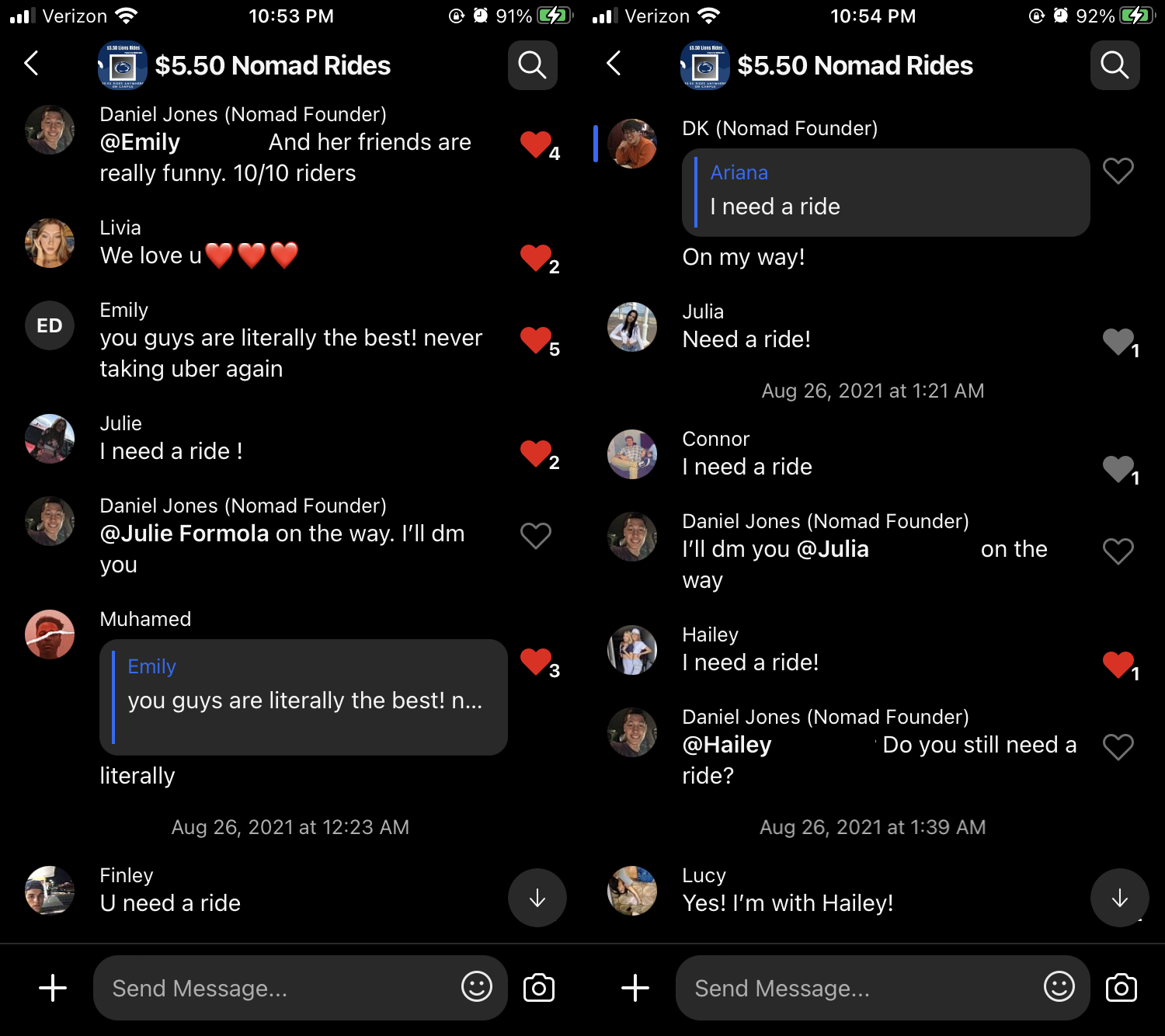
Initially, the group chat was met with confusion as the ambassadors incredulously broadcasted their ride requests, “I need a ride…? Is this how it works…?” But after facilitating approximately ten rides, the momentum in the group chat built up & exploded. Students fell in love with the simplicity of the experience citing that it felt like texting your friends to pick you up. Users would excitedly add their friends into the group chat and the newly recruited students could easily understand how the product worked by observing & copying each other. They also weirdly loved the Social+ aspect of broadcasting their rides into a Venmo-esque feed. My favorite story was when three girls requested a ride to the bar together only to have two of them ditch their friend to go somewhere else. The third friend later saw her friends’ ride request in the group chat and posted, “Wait, y’all just left me?!” Everyone in the group chat could see this exchange and as you can tell, we were all very entertained 😂.
Within two days of launching, our group chat became the most talked about topic on campus. Nomad had infiltrated every conversation with students asking each other if they had a chance to try this weird service that lets you get cheap Uber rides on GroupMe. Within our group chats, students posted shoutouts raving about our drivers and eagerly added their friends. Within a week of launching, the group chat exploded with 50-100 requests coming in per minute at its peak, which broke our system of manually dispatching the rides. This was when we directed the students to our app. “Hey everyone! I’ve been dispatching rides by inputting the ride requests into our app, but there are too many requests coming in… If you download Nomad Rides from the App Store, you’ll get picked up faster. Btw, we’ll only take rides on the app moving forward. 🙃”
The result from the GroupMe experiment was absolutely bananas and our team was ecstatic. This was the fastest that we had ever grown. In fact, we hit ride volumes that would have previously taken us 4-5+ weeks in just 4-5 days. Looking back, aggregating rides off the app was a counter-intuitive approach and something that nearly killed our company (this is a story for another time 😉). But why in the world was it so successful? There were a couple of things that we nailed down which made the product experience valuable:
Simplifying & expediting the user’s path of hitting the aha moment. When we directed users to the app, everyone exclaimed, “Oh, why didn’t you tell us there was an app!? We would have requested rides there!” But the truth is, they wouldn’t have. We tried everything — advertising on Facebook, giving away free rides, flyering dorms, scraping thousands of student emails from the University’s directory, and even wearing a cow costume in front of a bar line (I know, you must be thinking, what in the world!?!?) — but were brutally ignored. On the other hand, GroupMe provided an easy way for users to experience Nomad. Once the users tried our service, they understood its value and were willing to go through the additional inconvenience associated with downloading a new app.
GroupMe was the perfect distribution channel to reach our target users. When building products, I like to think that you should be able to visualize a place where you can find your bulls-eye target users. For us, GroupMe was the obvious destination as students were on the app for 3-5 hours/day for their classes, extracurriculars, and social life. We could easily target them without pulling them off the existing network/behavior. The group chat was also a terrific way for us to capture users at their points of intent for rideshare. e.g. when users opened their app to message their friends before heading out of the dorm/bar/restaurant, they were reminded of Nomad as our group chat would always show up at the top as other students messaged the group for rides.
GroupMe drove organic growth with an extremely high viral coefficient. Ridesharing is an inherently viral product as users typically take rides together. We would frequently see the student who requested the ride add their fellow passengers to the group chat en route. And the best thing about this invite system was the permission-less nature: the friend who got added didn’t have to lift a finger (go to the App Store, search/download an app, create an account, etc). They were instantly added and could request rides on the way back.
Finally, GroupMe was a terrific way for us to quickly overcome the trust barrier. For the wary students who weren’t convinced by the legitimacy of our service even after seeing our Forbes article, the group chat became a public ledger where anyone could easily verify the safety of the transported students. The Venmo-esque broadcasting feed of ride requests and raving reviews of our drivers from the most popular sorority students propelled Nomad’s status into the next big thing everyone wanted to be associated with.
Well, that’s it! Hopefully, this was a fun story that inspired you to think about your product’s aha moment as well as ways to help new users hit this point as quickly as possible. See you next week! 🙃
👋 Hello there! I go by DK and I formerly scaled a YC-backed commission-free ridesharing company to 300k+ rides as a founding member & growth operator. I’m building products at Instacart and investing across consumer social & crypto. You can reach me @ www.danielkwun.com